Your Small Kitchen Deserves a Big Makeover
Let’s be real — cooking in a cramped kitchen is frustrating. You bump into counters, can’t find anything, and feel like the walls are closing in. But here’s the good news: a small kitchen doesn’t have to feel small. With the right kitchen interior design choices, even the tiniest cooking space can feel open, functional, and absolutely beautiful.
Whether you’re renting an apartment, living in a cozy home, or just dealing with a kitchen that never seems to have enough room, this guide is for you. You don’t need a massive renovation budget or a professional designer on speed dial. What you need are smart ideas — and that’s exactly what you’ll find here.
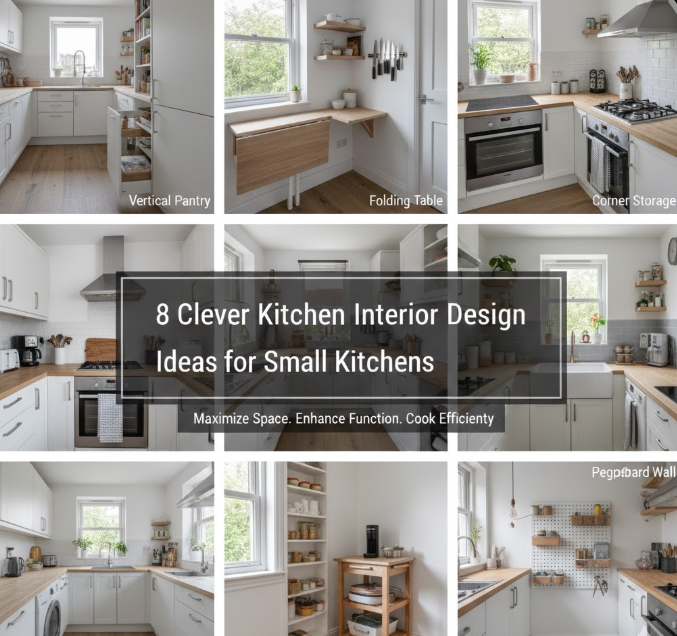
In this article, we’ll walk through 8 clever kitchen interior design ideas that are practical, affordable, and easy to pull off. From lighting tricks to cabinet hacks, every tip here is designed to help you get more out of your space without tearing down walls.
Let’s dive in.
Why Small Kitchen Design Is a Different Challenge Altogether
Designing a small kitchen isn’t just about making things look pretty. It’s about solving real problems — lack of storage, poor lighting, awkward layouts, and that constant feeling of clutter.
Big kitchens are forgiving. You can afford to waste a little space here and there. Small kitchens? Not so much. Every single inch matters.
That’s why kitchen interior design for compact spaces requires a completely different mindset. Instead of thinking about what you want to add, you start thinking about how to use what you already have — more cleverly, more efficiently, and more beautifully.
The ideas below are built on that exact principle.
Idea #1: Go Vertical — Use Your Walls Like a Pro
Most people forget that walls are storage space too. In a small kitchen, your walls are some of the most valuable real estate in the room — and most of us just leave them empty.
Stack It Up: Open Shelving Done Right
Open shelves are one of the most popular trends in modern kitchen interior design, and for good reason. They make a kitchen feel more open than closed cabinets do, and they put your most-used items right within reach.
Install two or three shelves above your counter space. Use them to store dishes, glasses, spices, and small appliances. The key is to keep them organized — messy open shelves make a small kitchen look even more cluttered.
Use matching containers and jars for a clean, cohesive look. Group items by category. And don’t overcrowd the shelves — leave a little breathing room between objects.
Magnetic Strips and Pegboards
A magnetic knife strip mounted on the wall saves an entire drawer. A pegboard lets you hang pots, pans, utensils, and even small baskets — keeping your counters clear and your tools easy to grab.
These simple additions can dramatically change how functional your kitchen feels without taking up any floor or counter space.
Idea #2: Choose the Right Color Palette to Open Up the Space
Color is one of the most powerful tools in kitchen interior design. The right color can make a small kitchen feel twice as large. The wrong one can make it feel like a closet.
Light Colors Are Your Best Friend
Light, neutral tones — think white, cream, soft gray, or pale beige — reflect natural and artificial light. This makes the space feel brighter and more open. Painting your walls, cabinets, and even your ceiling in light tones creates a seamless, airy look that visually expands the room.
You don’t have to go all-white if that feels boring to you. A soft sage green, a warm off-white, or a light blush can add personality while still keeping things open and fresh.
The Power of a Monochromatic Scheme
Using one color (or closely related shades of the same color) throughout the kitchen creates visual continuity. When the eye doesn’t have to jump between contrasting colors, the space feels calmer and larger.
For example, pairing light gray cabinets with a slightly darker gray backsplash and white countertops keeps everything connected and visually spacious.
| Color Scheme | Effect on Space | Best For |
|---|---|---|
| All White | Maximum brightness and openness | Very small or dark kitchens |
| Soft Neutrals (cream, beige) | Warm and airy feel | Cozy, traditional kitchens |
| Monochromatic Gray | Clean and modern, visually spacious | Contemporary small kitchens |
| Pale Green or Blue | Refreshing and open | Kitchens with natural light |
| Dark Colors | Bold but can shrink space if overused | Accent walls only |
Idea #3: Smart Cabinet Choices That Do Double Duty
Cabinets take up a huge amount of visual and physical space in any kitchen. In a small kitchen, you need your cabinets to work harder than ever.
Floor-to-Ceiling Cabinets
One of the best upgrades you can make is extending your cabinets all the way to the ceiling. Most standard cabinets stop a foot or two below the ceiling, leaving a gap that collects dust and does nothing useful.
Floor-to-ceiling cabinets give you significantly more storage and draw the eye upward, making the room feel taller. Store everyday items at eye level and use the top sections for things you don’t need as often — seasonal items, large serving platters, or backup supplies.
Pull-Out Drawers and Lazy Susans
Deep cabinets are notorious for swallowing things whole. You put something in the back and never see it again. Pull-out drawers and lazy Susan turntables solve this problem by bringing everything to you instead of making you dig.
These small upgrades are relatively affordable and make a massive difference in how easy it is to find and access what you need.
Toe-Kick Drawers
Here’s one most people never think about: the space beneath your lower cabinets. Those toe-kick panels at the base of your cabinets are usually just decorative covers — but they can be converted into shallow pull-out drawers. Perfect for storing flat items like baking sheets, cutting boards, or table linens.
Idea #4: Let the Light In — Lighting Strategies That Work
Poor lighting makes a small kitchen feel dark, cramped, and unwelcoming. Good lighting does the opposite — it opens up the space, makes it easier to cook safely, and adds a huge boost to the overall feel of the room.
Layer Your Lighting
Great kitchen design uses three types of lighting together:
Ambient lighting is your main overhead light — it illuminates the whole room.
Task lighting focuses on specific work areas, like under-cabinet LED strips that light up your counter space where you prep food.
Accent lighting is decorative — think small LED lights inside glass cabinets or a warm strip light along the top of your upper cabinets.
When you combine all three, the kitchen feels dynamic, functional, and much larger than it is.
Natural Light Tricks
If your kitchen has a window, make the most of it. Avoid heavy curtains that block light. Instead, use sheer or no window treatments at all. Place a mirror or reflective surface across from the window to bounce that natural light deeper into the room.
If natural light is limited, choose warm white LED bulbs (around 3000K) for a cozy, bright feel that mimics daylight without being harsh.
Idea #5: The Magic of Mirrors and Reflective Surfaces
You might not think of mirrors as a kitchen thing — but they’re one of the most underrated tricks in small-space kitchen interior design.
Mirrored Backsplashes
A mirrored or highly reflective backsplash bounces light around the room and creates the illusion of depth. It makes your kitchen look wider and more open without changing a single structural element. Glossy subway tiles, stainless steel panels, and mirror tiles all achieve a similar effect.
Glossy Cabinet Finishes
High-gloss cabinet doors reflect light just like a mirror. They’re sleek, modern, and incredibly effective at making a small kitchen feel bigger. The downside? They show fingerprints easily. But a quick wipe keeps them looking sharp.
Metallic Hardware and Fixtures
Swapping out dull hardware for chrome, brass, or brushed nickel handles and faucets adds small reflective touches throughout the kitchen. It’s a tiny change with a surprisingly big visual impact.
Idea #6: Rethink Your Layout — Small Tweaks, Big Results
The layout of your kitchen has more impact on how it functions than almost anything else. And sometimes, just rearranging a few things — without any major renovation — can completely change how the space works.
The Work Triangle Rule
The classic kitchen design principle is the work triangle: the path between your stove, sink, and refrigerator should form a triangle, with each side between 4 and 9 feet. When these three elements are positioned well, cooking becomes much more efficient — you’re not constantly walking back and forth across the kitchen.
In a small kitchen, keeping this triangle tight (but not cramped) is essential.

Galley vs. L-Shape vs. U-Shape: Which Works Best?
| Layout | Best For | Pros | Cons |
|---|---|---|---|
| Galley (two parallel counters) | Very narrow kitchens | Efficient workflow, max counter space | Can feel tunnel-like |
| L-Shape | Corner kitchens | Open feel, good for dining combos | Corner space can be wasted |
| U-Shape | Square small kitchens | Maximum storage and counter space | Can feel enclosed |
| Single Wall | Studio or tiny apartments | Saves floor space | Limited counter and storage |
Consider a Rolling Island
If your layout allows, a rolling kitchen island is a game changer. It adds counter space and storage when you need it, and rolls out of the way when you don’t. Look for one with shelves or drawers underneath for bonus storage.
Idea #7: Declutter and Organize Like a Minimalist
This one isn’t glamorous — but it might be the most impactful idea on this list. No amount of good kitchen interior design can save a kitchen drowning in clutter.
The One-In, One-Out Rule
For every new item you bring into the kitchen, one old item has to leave. This simple rule keeps clutter from building up over time and forces you to be intentional about what you keep.
Drawer Dividers and Cabinet Organizers
Junk drawers are the enemy of small kitchens. Drawer dividers keep utensils sorted and easy to find. Cabinet organizers — like tiered shelf risers, can racks, and door-mounted holders — dramatically increase the usable space inside your cabinets.
Countertop Rules: Keep It Minimal
Your counter space is precious. The only things that should live on your counter permanently are the appliances you use every single day — like your coffee maker or toaster. Everything else should have a home inside a drawer or cabinet.
Clear counters make your kitchen look instantly larger and cleaner. It’s the easiest transformation you can make with zero cost.
Transparent Storage Containers
Using clear jars and containers for dry goods (pasta, rice, cereal, coffee) serves two purposes: it looks great and it makes it easy to see when you’re running low. Uniform containers also stack neatly, saving shelf and cabinet space.
Idea #8: Add Personality Without Adding Clutter
Here’s where fun meets function. A small kitchen can still have a strong personality and a beautiful style — you just have to be intentional about it.
One Statement Piece
Instead of decorating every surface, choose one statement element that becomes the focal point of your kitchen. It could be a bold-colored island, a patterned tile backsplash, a vintage light fixture, or a striking piece of wall art. One strong element does more for a room’s character than a dozen small decorations.
Plants That Actually Belong in a Kitchen
A few small plants or herbs on a windowsill or a floating shelf add life and color to a kitchen without adding clutter. Fresh herbs like basil, mint, or rosemary are also functional — you can cook with them. Win-win.
Cohesive Hardware and Fixtures
Matching your cabinet hardware, faucet, light fixtures, and even your appliance finishes creates a polished, intentional look. When everything is cohesive, the kitchen feels designed — not thrown together. This is one of those small details that separates a beautiful kitchen from a forgettable one.
For more inspiration on creating stunning, functional living spaces, check out Inspirations for Interiors — a fantastic resource for home design ideas across every room. You can also explore the National Kitchen & Bath Association for professional standards and expert design guidance.
Quick Comparison: Before vs. After These Design Ideas
| Element | Before | After |
|---|---|---|
| Walls | Bare and unused | Shelves, pegboards, magnetic strips |
| Color | Dark or mismatched | Light, cohesive palette |
| Cabinets | Standard height, hard to access | Floor-to-ceiling, pull-outs, lazy Susans |
| Lighting | Single overhead bulb | Layered ambient, task, and accent lighting |
| Backsplash | Plain tile | Reflective or mirrored surface |
| Layout | Inefficient workflow | Optimized work triangle |
| Counters | Covered in appliances | Minimal, only essentials out |
| Style | Random decorations | One focal point, cohesive hardware |
Small Kitchen Design: Mistakes to Avoid
Even with the best intentions, small kitchen makeovers can go wrong. Here are a few common mistakes to steer clear of:
Overcrowding open shelves — Open shelves look beautiful when they’re curated. But when you stuff every inch, they make the kitchen feel messier than closed cabinets would.
Ignoring the ceiling — The vertical space above your cabinets and your actual ceiling height are both underused assets. Use them.
Buying appliances that are too big — A giant stand mixer or a massive fridge that takes up too much floor space fights against everything you’re trying to achieve. Measure before you buy.
Going too trendy — Trends come and go. In a small kitchen, it’s smarter to build a classic, timeless foundation and add trendy touches with small, replaceable items like dish towels, plants, or small decor.
Forgetting ventilation — This isn’t just a comfort issue — it’s a practical one. A good range hood or ventilation system keeps smells and steam from taking over your small kitchen.
FAQs About Kitchen Interior Design for Small Spaces
Q: What is the best color for a small kitchen interior design? Light colors like white, cream, soft gray, and pale pastels work best. They reflect light and make the space feel more open. Avoid very dark colors on all walls and cabinets, though a dark accent element can add depth without shrinking the room.
Q: How do I make a small kitchen look bigger without renovating? Focus on lighting, color, and decluttering first. Add mirrors or reflective surfaces, clear your counters, install under-cabinet lighting, and use open shelving. These changes cost very little but create a dramatic visual difference.
Q: Are open shelves a good idea in a small kitchen? Yes — but only if you keep them organized. Open shelves remove visual bulk and make a kitchen feel more open. The key is using matching containers, leaving some breathing room, and keeping things tidy.
Q: What kitchen layout works best for a small space? It depends on your kitchen’s shape. Galley layouts are great for narrow kitchens. L-shapes work well in corners. U-shapes maximize storage in square rooms. Single-wall layouts are ideal for studio apartments or very tiny spaces.
Q: How can I add storage to my small kitchen without a full renovation? Use wall-mounted shelves, pegboards, magnetic strips, pull-out organizers, door-mounted holders, and toe-kick drawers. A rolling island adds both storage and counter space without permanent installation.
Q: Is it worth hiring a designer for a small kitchen? If your budget allows, a professional designer can spot opportunities you might miss and help you avoid costly mistakes. But many of the ideas in this article are completely DIY-friendly and don’t require professional help.
Q: What type of lighting is best for a small kitchen? Layered lighting works best — combine overhead ambient lighting with under-cabinet task lighting and a few accent lights. Use warm white LEDs (around 3000K) for a bright but cozy feel.
Wrapping It All Up: Your Small Kitchen, Reimagined
A small kitchen doesn’t have to mean a limited kitchen. With the right kitchen interior design strategies, you can create a space that feels bigger, works better, and looks incredible — without tearing anything down or spending a fortune.
Start with the basics: go vertical, lighten your color palette, declutter your counters, and upgrade your lighting. Then layer in the smarter details — reflective surfaces, optimized layouts, cohesive hardware, and one strong focal point.
The best part? You don’t have to do everything at once. Pick one idea from this list and start there. Make one change, see how it feels, and build from there. Small kitchens are transformed one smart decision at a time.
Your kitchen has more potential than you think. It’s time to unlock it.
Ready to explore more home design ideas? Visit Inspirations for Interiors for beautiful, practical inspiration for every corner of your home.