Your Small Home Deserves Big Style
Living in a small home doesn’t mean living with less. In fact, modern home interior design has made it easier than ever to turn a compact space into something truly beautiful and functional. Whether you’re working with a studio apartment, a small townhouse, or a cozy cottage, the right design choices can completely change how your home looks and feels.
Small spaces come with real challenges. Storage is tight. Rooms feel cramped. Natural light gets blocked. But here’s the good news — millions of homeowners around the world are solving these exact problems with smart, stylish design strategies.
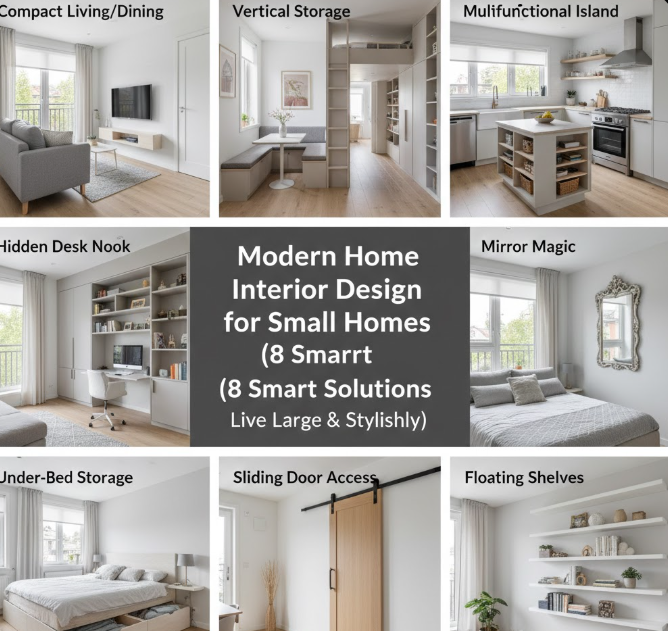
This article walks you through 8 proven solutions that interior designers use every day. Each one is practical, affordable, and works beautifully in small homes. By the end, you’ll have a clear plan to transform your space without knocking down walls or blowing your budget.
Let’s get started.
Why Modern Interior Design Works So Well in Small Spaces
Modern design is built on three core ideas: simplicity, function, and purpose. Every piece of furniture, every color choice, and every lighting decision should serve a reason. That philosophy is perfect for small homes, where wasted space is simply not an option.
Unlike older, more decorative styles, modern home interior design removes the clutter and focuses on what matters. Clean lines replace bulky furniture. Neutral tones replace loud patterns. Smart storage replaces messy piles.
The result? A home that feels calm, open, and surprisingly spacious.
Solution 1 — Use Light Colors to Open Up the Room
Color is one of the most powerful tools in modern home interior design. And in small spaces, it can literally make walls appear to move back.
Why Light Colors Work
Light colors — like white, soft gray, beige, and pale blue — reflect natural light. When light bounces off your walls, the room immediately feels larger and more open. Dark colors, on the other hand, absorb light and make a room feel smaller and heavier.
This doesn’t mean your home has to look plain or boring. You can add personality through accent walls, colorful throw pillows, artwork, or plants — while still keeping your base palette light and airy.
Best Color Combinations for Small Homes
| Color Combo | Effect on Space | Best Used In |
|---|---|---|
| White + Light Gray | Crisp, clean, modern | Living rooms, bedrooms |
| Soft Beige + Cream | Warm and welcoming | Kitchens, dining areas |
| Pale Blue + White | Fresh, open, airy | Bathrooms, small bedrooms |
| Light Green + Wood Tones | Natural and calming | Home offices, studios |
| All-White + Texture | Bright and layered | Any small room |
Pro Tip: Paint your ceiling the same color as your walls (or slightly lighter). It draws the eye upward and makes the room feel taller.
Solution 2 — Choose Furniture That Does Two Jobs at Once
In a small home, every piece of furniture needs to earn its place. That’s why multi-functional furniture is a cornerstone of modern home interior design for compact spaces.
Smart Furniture Picks for Small Homes
Think about furniture that pulls double duty. A sofa with hidden storage underneath. A bed with built-in drawers. A dining table that folds against the wall when you’re done eating. These aren’t just clever — they’re space-saving lifesavers.
Here are some top multi-functional furniture options:
Storage Ottoman — Acts as a coffee table, extra seating, and a storage box all in one.
Murphy Bed (Wall Bed) — Folds into the wall during the day, turning your bedroom into a usable living or work space at night.
Extendable Dining Table — Stays compact when it’s just you or two people, then expands when guests come over.
Nesting Tables — Stack together when not in use, then spread out when you need extra surface space.
Convertible Sofa — Functions as a couch during the day and flips into a bed for overnight guests.
Furniture Sizing Guide for Small Rooms
| Room | Furniture Type | Recommended Size |
|---|---|---|
| Small Living Room | Sofa | Max 84 inches wide |
| Small Bedroom | Bed | Queen or Full (not King) |
| Tiny Kitchen | Dining Table | 36–48 inch round |
| Compact Home Office | Desk | Wall-mounted or fold-down |
| Small Bathroom | Vanity | 24–30 inches wide |
The key rule: measure your space first, shop second. Even one inch too wide can make a room feel crowded.
Solution 3 — Let Natural Light Flow Freely
Natural light can make any room look twice as big. Modern home interior design loves big windows, open sightlines, and reflective surfaces for exactly this reason.
How to Maximize Natural Light
Start by taking a hard look at what’s blocking your windows. Heavy curtains? Move-in furniture? Shelves placed too close to the glass? Even small adjustments here can dramatically brighten your space.
Use sheer or light-filtering curtains instead of heavy drapes. They let sunlight in while still giving you privacy.
Hang mirrors across from windows. Mirrors reflect light and essentially double the brightness in a room. A large mirror on a wall opposite a window is one of the oldest — and most effective — tricks in the design book.
Keep window sills clear. Avoid placing plants, décor, or furniture that blocks the lower portion of your windows.
Use glass furniture. Glass coffee tables, acrylic chairs, and lucite shelves allow light to pass through them rather than stopping it dead.
Light Source Comparison
| Light Source | Effect on Small Room | Cost Level |
|---|---|---|
| Natural window light | Best for making space feel larger | Free |
| Recessed ceiling lights | Clean, modern, no visual clutter | Medium |
| Floor lamps | Adds warmth, fills dark corners | Low |
| Under-cabinet lighting | Useful and stylish in kitchens | Low–Medium |
| Mirrors (reflected light) | Instantly doubles light in a room | Low–Medium |
Solution 4 — Go Vertical and Use Wall Space Wisely
When floor space is limited, the answer is simple — go up. Modern interior design for small homes encourages using vertical space as much as possible.
Think from Floor to Ceiling
Most people only use furniture that sits on the floor. But walls offer enormous opportunities. Floor-to-ceiling shelving, tall bookcases, wall-mounted cabinets, and hanging storage systems can hold a tremendous amount of stuff without eating up any floor space.
Floating shelves are especially popular in modern design. They look clean, hold a lot, and can be installed anywhere — above the sofa, next to the TV, in the bathroom, or in a hallway.
Tall wardrobes that reach the ceiling use every inch of vertical space. Pair them with a small step stool for the top shelves.
Pegboards in the kitchen or home office keep tools and supplies visible and accessible without taking up counter or desk space.
Best Vertical Storage Ideas by Room
Kitchen: Hang pots and pans on a ceiling rack. Mount a magnetic knife strip on the wall. Use tall pantry cabinets.
Bedroom: Install a floor-to-ceiling wardrobe. Use a bed with storage drawers. Mount bedside tables on the wall instead of placing them on the floor.
Living Room: Use tall, slim bookshelves. Mount your TV on the wall instead of using a TV stand.
Bathroom: Add shelves above the toilet. Use tall, narrow storage towers. Install hooks on the back of the door.
Solution 5 — Embrace the Open Plan Layout
One of the biggest trends in modern home interior design is the open-plan layout — removing walls between the kitchen, dining, and living areas to create one large, flowing space.
Why Open Plans Feel Bigger
When rooms are separated by walls, each individual space feels small and boxed in. Remove those dividers, and the same square footage suddenly feels much more generous. Your eyes can travel farther, light moves more freely, and the whole home feels connected.
You don’t always have to tear down walls to achieve this effect. Here are some easier ways to create an open-plan feel:
Use furniture instead of walls. A sofa with its back to the kitchen can define your living area without blocking the sightlines.
Choose consistent flooring throughout. When the same flooring flows from room to room, the space feels unified and larger.
Use a single, cohesive color palette. When adjacent spaces share similar colors, the transition feels seamless.
Use rugs to define zones. Instead of walls, use area rugs to separate the “living room zone” from the “dining zone” in an open space.
Solution 6 — Declutter and Embrace Minimalism
Here’s a truth that every interior designer will tell you: the biggest enemy of a small home is clutter. Too much stuff makes any room feel chaotic, cramped, and stressful — no matter how good the furniture or paint color is.
The Minimalist Mindset for Small Homes
Minimalism doesn’t mean owning nothing. It means owning the right things. In modern home interior design, less is almost always more — especially in small spaces.
Start with a simple rule: if you haven’t used it in six months, it probably doesn’t need to live in your home. Donate, sell, or store items that don’t earn their place.
Then, organize what’s left. Smart storage solutions — like labeled bins, drawer dividers, hooks, and baskets — keep things tidy and easy to find.
Quick Declutter Checklist
- ✅ Clear all surfaces (counters, tables, shelves)
- ✅ Remove furniture that isn’t regularly used
- ✅ Organize cables and cords out of sight
- ✅ Store seasonal items (coats, holiday décor) in labeled boxes
- ✅ Limit decorative items to a few carefully chosen pieces
- ✅ Keep floors clear — floor clutter shrinks a room fast
Remember: A well-organized small home always feels more spacious than a larger home full of clutter.
Solution 7 — Use Mirrors and Reflective Surfaces Strategically
We touched on mirrors in the lighting section, but they deserve their own spotlight. Mirrors are one of the most powerful and affordable tools in modern home interior design — especially for small spaces.
The Magic of Mirrors
A large mirror doesn’t just reflect light. It also creates the illusion of depth. When you look at a mirror, your brain perceives the space behind it as an extension of the room. The result is a room that appears almost twice as deep as it actually is.
Here’s how to use mirrors and reflective surfaces effectively:
Place a large mirror on the wall facing the room’s main window. It will capture the natural light and bounce it back across the entire space.
Use a floor-length mirror in the bedroom or hallway. It elongates the space and makes ceilings look taller.
Choose furniture with reflective finishes — glass tabletops, mirrored cabinet doors, chrome hardware. These surfaces catch and scatter light throughout the room.
Consider mirrored backsplash tiles in the kitchen or bathroom. They reflect light, add a modern touch, and make narrow spaces feel wider.
Mirror Placement Guide
| Location | Mirror Size | Effect |
|---|---|---|
| Small living room | Large (48″+ wide) | Creates depth, reflects light |
| Narrow hallway | Full-length vertical | Makes space feel longer and taller |
| Small bedroom | Medium to large | Opens up the room |
| Tiny bathroom | Wall-to-wall above vanity | Dramatically expands visual space |
| Dark corner | Any size | Brightens and lifts the area |
Solution 8 — Smart Lighting Design for Every Corner
Lighting is the finishing touch of any great interior design. In small homes, smart lighting choices can completely transform the atmosphere — making a cramped room feel cozy and open at the same time.
Layer Your Lighting
Modern home interior design uses a concept called layered lighting, which means combining three types of light in each room:
Ambient Light — The main, overall light source. Usually ceiling lights or recessed lighting. It illuminates the whole room evenly.
Task Light — Focused light for specific activities. Desk lamps, under-cabinet kitchen lighting, and reading lamps all count as task lighting.
Accent Light — Decorative lighting that highlights specific features. Think LED strip lights behind the TV, wall sconces, or small spotlights aimed at artwork.
When you layer all three, the room has depth, warmth, and visual interest — without ever feeling flat or harsh.
Lighting Tips Specific to Small Homes
Avoid large hanging pendant lights in rooms with low ceilings. They eat up valuable vertical space and can make the ceiling feel even lower.
Use recessed (in-ceiling) lighting wherever possible. It provides great light without cluttering your visual space.
Add dimmer switches to control the mood. Bright light opens up a room; warm, dim light makes it feel cozy and intimate.
Light up dark corners with floor lamps or LED strip lights. Dark corners make rooms feel smaller. Eliminating them instantly expands the sense of space.
Real-World Impact: Before and After Comparison
| Design Element | Before (Traditional) | After (Modern Solutions) |
|---|---|---|
| Wall color | Dark navy or forest green | Soft white or light gray |
| Furniture | Large, heavy, non-functional | Multi-functional, appropriately sized |
| Lighting | Single ceiling bulb | Layered: ambient + task + accent |
| Storage | Floor-based, overflowing | Vertical, hidden, organized |
| Décor | Many small items everywhere | A few curated, meaningful pieces |
| Mirrors | None or small | Large, strategically placed |
| Layout | Closed rooms, divided walls | Open-plan or semi-open feel |
| Overall Feel | Cramped, cluttered, dark | Spacious, clean, bright |
How These 8 Solutions Work Together
Each of these solutions is powerful on its own. But the real magic happens when you use them together. Think of them as a system, not a checklist.
Light colors create brightness. Multi-functional furniture reduces clutter. Open layouts improve flow. Vertical storage frees up the floor. Mirrors amplify the light. Smart lighting brings warmth and depth. Minimalism ties it all together.
When you apply even 4 or 5 of these ideas in a single room, the transformation can be stunning — without a full renovation or a huge budget.
For more inspiration and professional ideas tailored to real homes, visit Inspirations for Interiors — a great resource for homeowners looking to create stylish, functional spaces.
You can also check out the Houzz Small Space Design Guide for real-life examples and community-shared photos of beautifully designed compact homes.
Quick Summary: 8 Smart Modern Interior Design Solutions
| # | Solution | Key Benefit |
|---|---|---|
| 1 | Light Color Palette | Makes rooms feel larger and brighter |
| 2 | Multi-Functional Furniture | Saves space while increasing functionality |
| 3 | Maximize Natural Light | Opens up the space, improves mood |
| 4 | Vertical Storage | Uses height to free up floor space |
| 5 | Open Plan Layout | Creates visual flow and openness |
| 6 | Minimalism & Decluttering | Removes visual noise and stress |
| 7 | Mirrors & Reflective Surfaces | Creates depth and doubles light |
| 8 | Layered Lighting | Adds warmth, depth, and personality |
Frequently Asked Questions (FAQs)
Q1: What is the best modern home interior design style for small spaces?
The best style for small spaces is minimalist modern design. It focuses on clean lines, neutral colors, functional furniture, and clutter-free living. This style maximizes every inch of your home without making it feel sterile or empty.
Q2: How do I make a small living room look bigger with modern design?
Use light wall colors, place a large mirror on one wall, choose a sofa that fits the room (not one that overwhelms it), and use recessed or floor lighting instead of bulky lamp fixtures. Remove unnecessary furniture and keep surfaces clear.
Q3: Can modern home interior design work on a tight budget?
Absolutely. Many of the most effective changes — like repainting walls, rearranging furniture, adding mirrors, or decluttering — cost very little or nothing at all. Multi-functional furniture is a slightly bigger investment but saves money long-term by replacing multiple pieces with one.
Q4: Is an open-plan layout suitable for every small home?
Not always. Some homes have structural walls that can’t be removed without professional help. However, you can simulate an open-plan feel using consistent flooring, cohesive colors, and furniture placement — without any construction.
Q5: What colors should I avoid in small rooms?
Avoid very dark colors like deep navy, forest green, or charcoal on all four walls. These absorb light and make rooms feel cave-like. If you love dark colors, use them as an accent — on one wall, in your cushions, or in your artwork — while keeping the rest of the room light.
Q6: How important is lighting in modern home interior design for small homes?
Lighting is extremely important — possibly the most underrated element of interior design. Poor lighting makes even a beautiful room feel dull and cramped. Layered lighting (ambient + task + accent) gives a small room depth, warmth, and a sense of space that no furniture arrangement alone can achieve.
Q7: How many decorative items should I keep in a small home?
There’s no exact number, but the rule of thumb is: display only what you love, and love only what you display. A few well-chosen pieces — a piece of art, a plant, a sculptural vase — have far more impact than shelves crowded with knick-knacks.
Small Home, Big Possibilities — Final Thoughts
Living in a small home is not a limitation. It’s a design challenge — and one that modern home interior design handles brilliantly. The right colors, the right furniture, the right lighting, and the right mindset can turn even the tiniest apartment into a home that feels open, stylish, and completely yours.
The 8 solutions in this article are not just theories. They’re practical, tested strategies that real homeowners use every day to make their compact spaces shine. You don’t need to do everything at once. Start with one room. Pick two or three strategies. See the difference. Then keep going.
Your small home has more potential than you think — and now you have the tools to unlock it.